Why one conversion factor cannot fix every lipid result
Milligrams per decilitre measure mass per volume, whereas millimoles per litre describe amount of substance per volume.
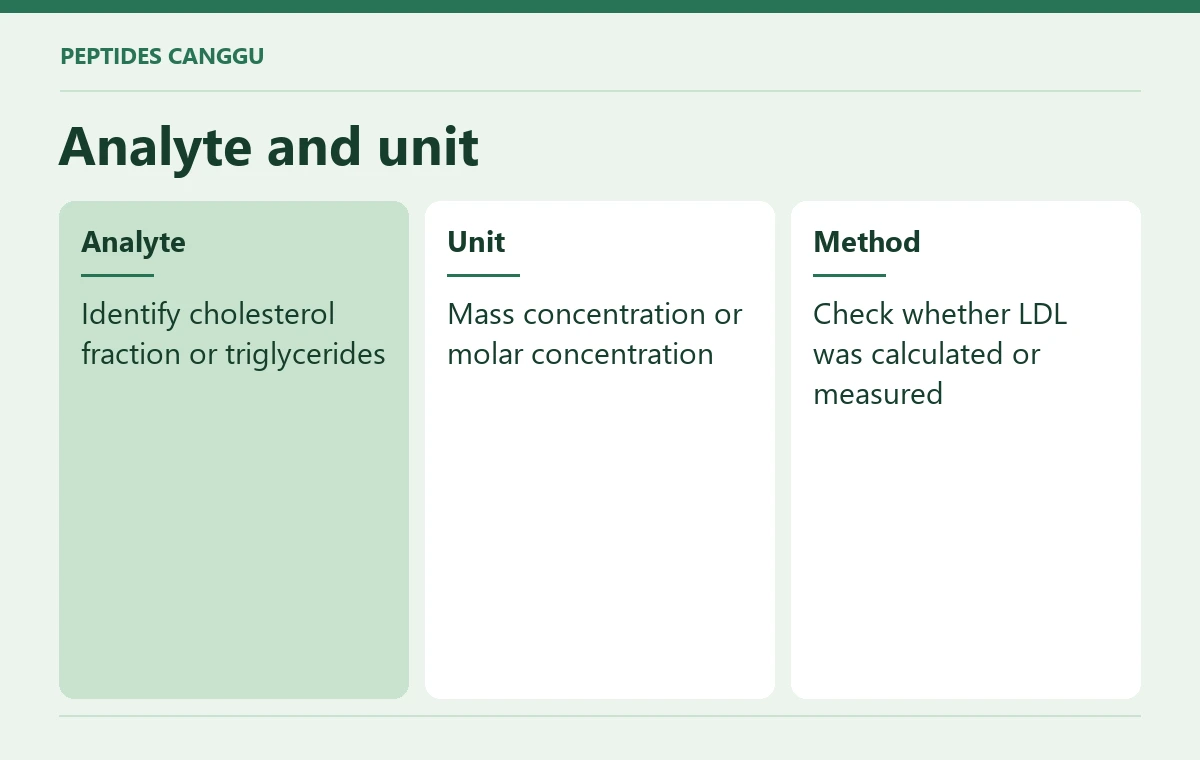
Milligrams per decilitre measure mass per volume, whereas millimoles per litre describe amount of substance per volume. A conversion depends on the substance. A factor used for cholesterol cannot automatically be used for triglycerides.
Converting a unit needs the identity of the substance
A lipid panel lists several distinct measurements, including total cholesterol, HDL cholesterol, LDL cholesterol and triglycerides. Laboratories can present results in different units and may label LDL as calculated or directly measured. MedlinePlus on the components of a lipid panel
A mass concentration and an amount-of-substance concentration are related through the mass associated with an amount of the particular chemical material. This is why there is no single universal switch from mg/dL to mmol/L for every number on a blood panel. A conversion selected for cholesterol must not be silently reused for triglycerides. Write the name beside each original unit. Where a website or calculator offers a drop-down menu, check that the selected substance corresponds to the row in the report.
An estimate and a direct result can share the same unit
A Bali resident compares two reports from different countries by applying the same conversion to every line. The cholesterol comparison may look plausible while the triglyceride line is wrong. A calculated LDL and a direct LDL may also reflect different methods even after units are aligned.
A lipid panel may report an LDL cholesterol value calculated from other measurements. A different laboratory may provide a direct LDL measurement. Aligning the units permits a numerical comparison, but it does not erase that methodological difference. A missing LDL value should not be replaced with a guessed number from a related marker. If an earlier result included a laboratory comment about how LDL was determined, keep the comment with the value. For a Bali consultation, share the full panels with their sample conditions so a clinician can decide which comparison answers the actual question.
When sharing the finding
If the first laboratory used a different reporting system, retain its original figures beside the converted values so the new clinician can check what was compared.
Two laboratory reports may also place results in a different order. Match names explicitly before comparing columns, particularly when total cholesterol and triglycerides have similar-looking numbers. A swapped row can produce an apparent change even when the unit conversion itself was performed correctly.
Keep an unedited copy of both panels and ask the laboratory or clinician to reconcile units and methods. Do not replace an original value with an app conversion whose analyte is unspecified.