Why a nearly even hop test can hide weakness in both legs
A limb-symmetry calculation compares one leg with the other.
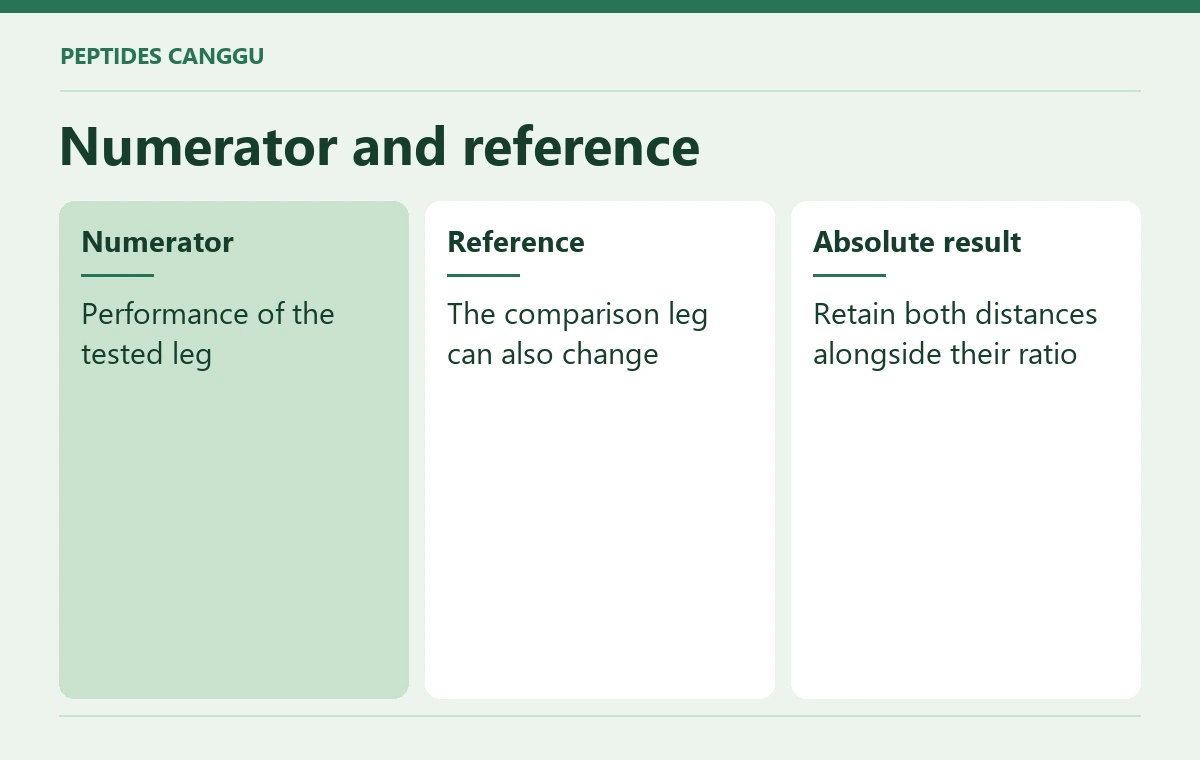
A limb-symmetry calculation compares one leg with the other. If both have lost capacity, the percentage can look reassuring even when neither leg is back to its earlier performance.
The reference side has its own history
A prospective ACL injury study found that symmetry indexes could overestimate knee function after reconstruction when the current uninvolved limb was used as the reference. That population and test protocol matter. Symmetry alone does not clear an athlete for return. Prospective ACL study of limb symmetry indexes
Before calculating a ratio, identify what happened to each leg between assessments. The comparison limb may have trained less during rehabilitation, been affected by an older injury, or improved while the injured side changed little. Each of these possibilities alters the meaning of a symmetry result. A simple record of both distances and the task used at each visit exposes these differences more readily than a single percentage.
What the original population contributes
Consider a surfer whose two recorded hop distances have both shortened during rehabilitation. The ratio can stay close to its earlier value while the actual distances fall. Looking only at the percentage erases the decline in the reference leg.
The primary study concerned people recovering from ACL injury and reconstruction. An observation about limitations of limb symmetry in that setting is a reason to read other tests carefully. It is not a validated numerical clearance standard for every knee or tendon injury. A clinician assessing a surf return may also need to consider pain, movement quality, strength and what happens after training. None can be calculated from the symmetry ratio in isolation.
Read the result in its original setting
There is a useful arithmetic check that needs no clinical cutoff. Compare a pair of distances with another pair exactly half as long on each side. Both pairs have the same left-to-right proportion despite very different distances. Now consider how the same ratio might change if the reference leg improves while the injured leg holds steady. A lower ratio need not mean the injured leg became weaker. The raw values show which side changed, while the clinical examination helps establish what that change means. Other tasks may also matter; a single straight-line hop cannot reproduce every twisting or landing demand in surfing.
If an earlier test used a different hopping task, note that change explicitly. A side-to-side proportion for distance and one for timed performance do not share the same underlying measurement.
Take the raw result for each leg and the date of each test to a Canggu physiotherapy review. Ask whether prior performance or additional functional assessments would change the interpretation.