The wrong cuff on a Bali home blood pressure monitor
A home reading is only as interpretable as the cuff and position used to obtain it.
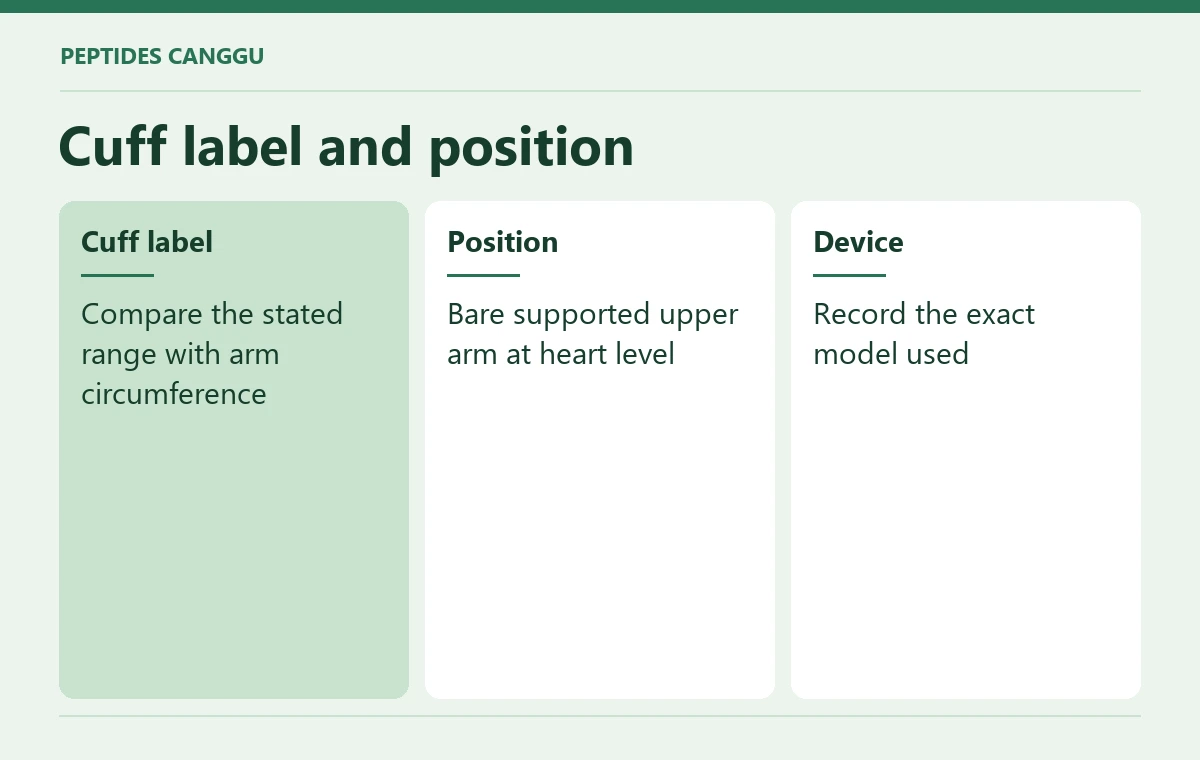
A home reading is only as interpretable as the cuff and position used to obtain it. For a Canggu appointment about home pressure, record the arm measurement range printed on the cuff as well as the monitor model.
Check the cuff on the actual arm
The American Heart Association recommends a validated upper-arm monitor with a properly fitting cuff. A cuff sold for an adult may still be the wrong size for that particular arm. Posture and arm support also matter. American Heart Association guide to home blood pressure measurement
A cuff is selected using its manufacturer's stated arm-size range. Terms such as standard or large are less useful than that printed range because they do not identify the exact product or size. If two cuffs came with one device, keep track of which one produced each group of readings. An arm that falls outside the fitted cuff's range is a measurement problem to resolve before interpreting the apparent pressure. Do not try to compensate by adding or subtracting a fixed number from every result.
Bring the whole device to the review
Imagine two travel companions comparing the same machine with different upper-arm circumferences. Agreement for one does not validate the fit for the other. A scaled photograph with a piece of clothing under the cuff cannot establish that measurement was correct.
A graph exported from a monitor preserves dates and values, but it may contain no information about cuff model, arm support or which arm was used. Add those observations in plain language. If clinic and home readings differ, the staff can first compare the conditions and check technique. That does not prove the difference arose from the cuff; it removes one avoidable ambiguity. If the original packaging is missing, look for the size range on the cuff itself or the manufacturer's instructions for that specific model.
What to keep with the result
Make a second entry when the cuff is replaced, even if the monitor stays the same. A series of home measurements may otherwise make an equipment change look like a sudden change in pressure. At the clinic, point out which readings were made before and after the replacement and ask whether comparing the two groups would be informative.
If more than one family member shares the monitor, identify whose readings entered its stored average. Some devices retain several people's measurements together unless a separate user profile was chosen.
Bring the actual monitor and cuff for comparison with the clinic's equipment. Ask which home readings are suitable for review, especially if the cuff, arm or measuring position changed partway through your log.