Is a small DXA change larger than measurement noise?
A small difference in bone mineral density between two scans is not necessarily a biological change.
A small difference in bone mineral density between two scans is not necessarily a biological change. The interpreting service uses its own precision assessment to judge whether a difference exceeds its least significant change.
Start with the instrument and scan site
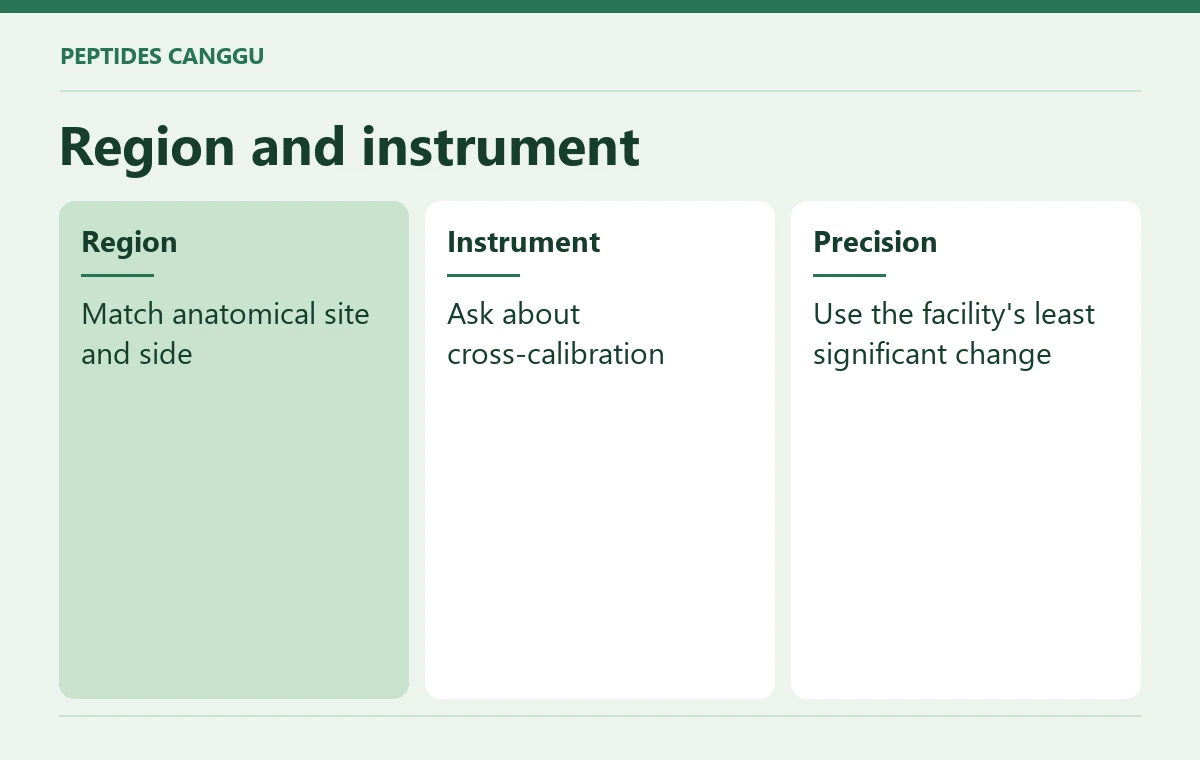
ISCD advises facilities to determine their own precision error and least significant change. Device comparisons and replacement equipment may require cross-calibration. A manufacturer's generic precision figure is not a substitute for the facility's own assessment. ISCD official adult DXA positions
A follow-up DXA report may compare a scan with the earliest baseline, the most recent prior scan, or both. Those comparisons span different intervals and can yield different changes without the report being inconsistent. Look for the explicit comparison date before discussing an increase or decrease. Also check the anatomical region, which side was examined and whether the interpreting service excluded any region because it could not be assessed reliably.
Ask for the facility's comparison statement
A Canggu resident had one hip scan overseas and a second at a new facility. Both report density in the same unit to several decimal places. Those extra digits do not make the two instruments directly interchangeable. Check which hip was measured and whether the earlier scan can be compared.
A report that identifies a significant change should indicate the comparison on which that statement is based. If the previous scan was performed elsewhere, ask what information the current service needs from the former facility. An original report and images can assist the inquiry, although possession of both does not guarantee that different instruments were cross-calibrated. It is reasonable to retain a prior scan as clinical history even when a precise numerical comparison is unsuitable.
What to bring to the next review
A decimal difference can be real in the sense that two printed numbers differ, yet too small to distinguish from repeat-measurement variability. This is a question about the measurement process and the facilities involved. It is distinct from the clinical importance of an established change. Meeting a statistical threshold for change does not automatically identify its cause; a clinician still considers fractures, medicines, illness and other relevant history. Conversely, a difference that cannot be interpreted across machines does not erase a new fracture or symptom. Discuss that observation directly. When possible keep the original density measurements and scan reports, rather than a series of rounded scores taken from patient portal screenshots.
Ask for the interpreter's statement on comparability, the actual density values and the site's threshold for a meaningful difference. A figure copied from a personal tracking app omits these conditions.