A hemoglobin variant flagged beside A1c: what the lab can clarify
A hemoglobin variant can interfere with some A1c methods but not others.
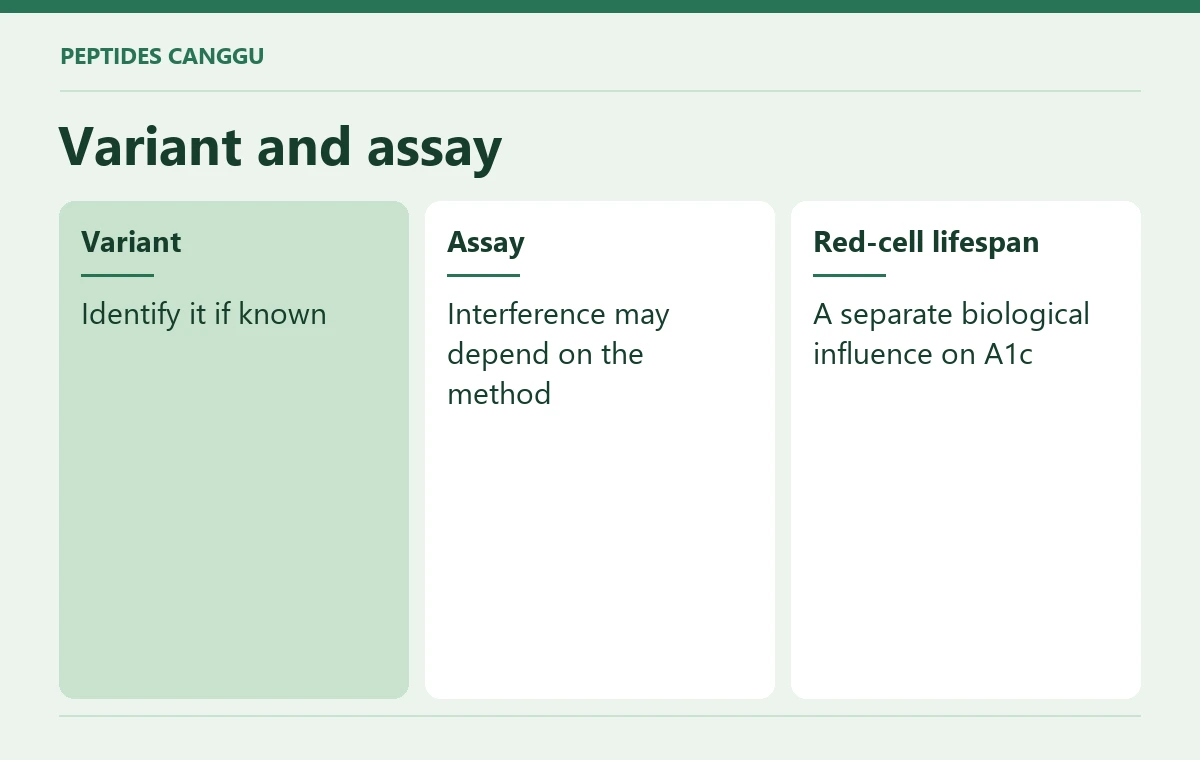
A hemoglobin variant can interfere with some A1c methods but not others. A flag on the report is a reason to identify the method and variant, rather than deciding that every future A1c is unusable.
What the laboratory method contributes
NIDDK explains that a laboratory may be able to use an appropriate assay for a particular hemoglobin trait. Conditions affecting the life of red cells raise a separate issue even when the assay itself handles a variant well. NIDDK on A1c and hemoglobin variants NIDDK guide to the A1C test
A1c methods do not all detect and quantify hemoglobin in exactly the same way. The presence of a particular variant may interfere with a particular method, while an alternative method may give an interpretable result. This issue concerns analytical measurement. A separate issue is how long red cells circulated, because A1c reflects exposure to glucose over the cells' lifetimes. A change in cell survival can alter interpretation even if the analytical method correctly measures the hemoglobin present in the sample.
Which result belongs in the next review?
A person moves to Canggu with an earlier A1c reported by one facility and a new result carrying a method comment. Take the full comment and recent glucose records to the diabetes review. A different company logo on the report does not tell which method was used.
Ask the laboratory to identify the assay used for the specific specimen. A facility may change equipment or send selected samples elsewhere, so a website describing the institution's usual instruments does not necessarily establish how the earlier sample was tested. If the variant is known, ask whether the testing service has a method appropriate to it. Other glucose information may assist the clinician. A home trace, however, covers its own observation window and cannot be transformed into an exact replacement result by adding a fixed correction to the reported A1c. Bring both sources with their dates and methods.
Read the result in its original setting
A trait, an assay susceptible to that trait and an observed discrepancy are three separate facts. Document which ones are actually established on the report.
If previous records mention a hemoglobin trait without naming it, say that the trait is unspecified. A laboratory cannot verify variant-specific interference from the word trait alone, and a clinician cannot reconstruct the exact earlier method from a rounded A1c value.
Ask whether the laboratory can identify the variant and assay, and which marker or observation period the clinician considers appropriate for follow-up. Do not adjust prescribed medicines on the basis of a method discrepancy alone.