Why your Bali clinic needs to know about a transfusion before interpreting HbA1c
Unexpected HbA1c after a hospital stay deserves a timeline. The life history of circulating red cells can change how the result relates to glucose.
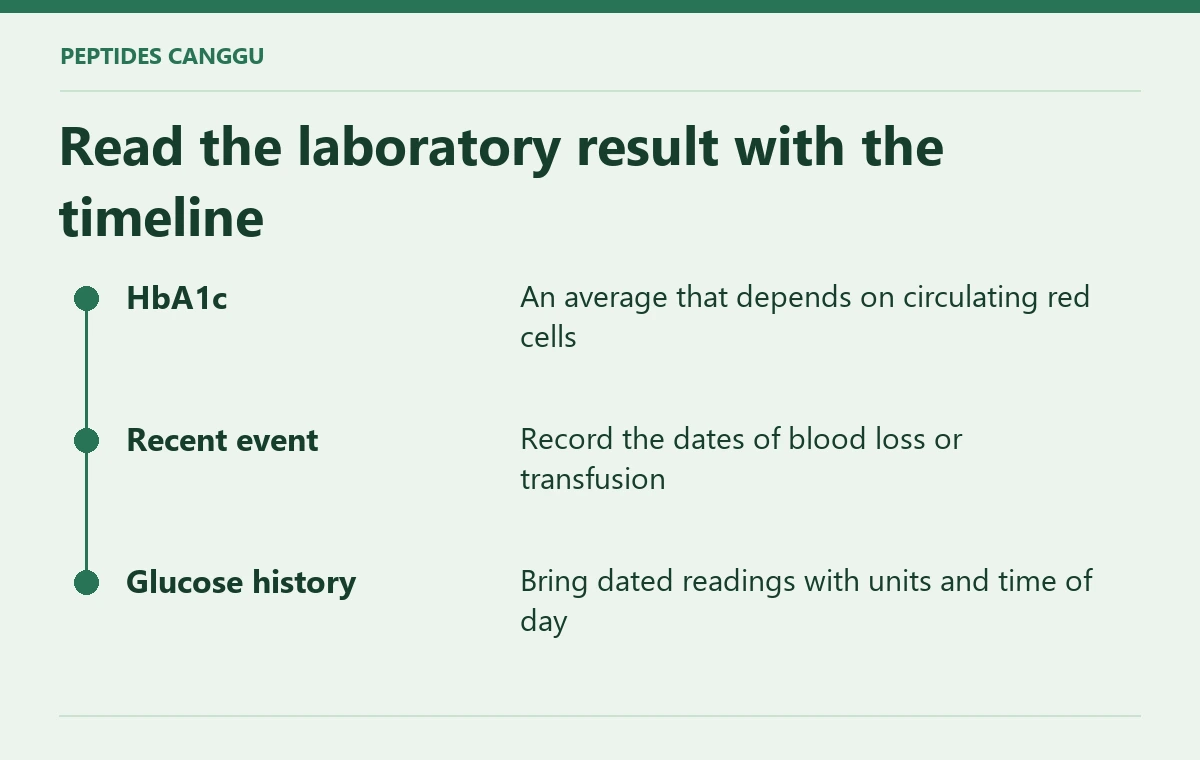
Suppose an HbA1c result looks appreciably lower than expected, while a person's dated glucose readings around a move to Bali look much like their earlier ones. Before calling it an improvement attributable to a diabetes medicine, put the hospital stay on the same timeline. Recent bleeding and a blood transfusion are details the laboratory report may not show. They can change what question the HbA1c result can answer.
The number has a biological clock
Haemoglobin in circulating red cells becomes glycated over time. A measurement therefore depends both on glucose exposure and on the population of red cells present when the sample is collected. NGSP's summary of factors affecting HbA1c explains that conditions shortening red-cell survival or reducing average cell age can produce a lower value relative to average glucose. Recovery from acute blood loss is one example.
A transfusion brings another person's red cells into the sample mixture. Its effect cannot be corrected by adding or subtracting a fixed percentage. The direction and magnitude in an individual depend on the circumstances. Preserve the number the laboratory reported. A corrected value invented later looks authoritative on a chart and can travel from one clinic to the next.
Build a timeline with three kinds of dates
Start with the sample date, then record the hospital admission and any known dates of bleeding or transfusion. Add dated glucose measurements and keep the units as reported. If using a continuous glucose monitor, indicate which dates the export actually covers. A few recent finger-stick readings and an HbA1c represent different time windows even when red-cell survival is ordinary.
For a consultation in Canggu, take the discharge summary if available. If the number of units transfused is unknown, the date and the fact of the event are still useful. Explain whether the laboratory that reported the HbA1c had access to that history.
Agree on what can guide the next decision
Ask which measurement your clinician considers reliable for the immediate decision and when HbA1c will add useful information again. Other markers have limitations of their own, so selecting an alternative depends on the clinical setting. A surprising value after a hospital admission is a reason to discuss the result before changing diabetes treatment. It is not a way to judge the effectiveness of a particular tirzepatide pen.