A dark stripe on one nail: what a Bali dermatologist will want to see
A newly appearing or changing dark band in a nail needs assessment, particularly if only one nail is involved or surrounding skin also changes.
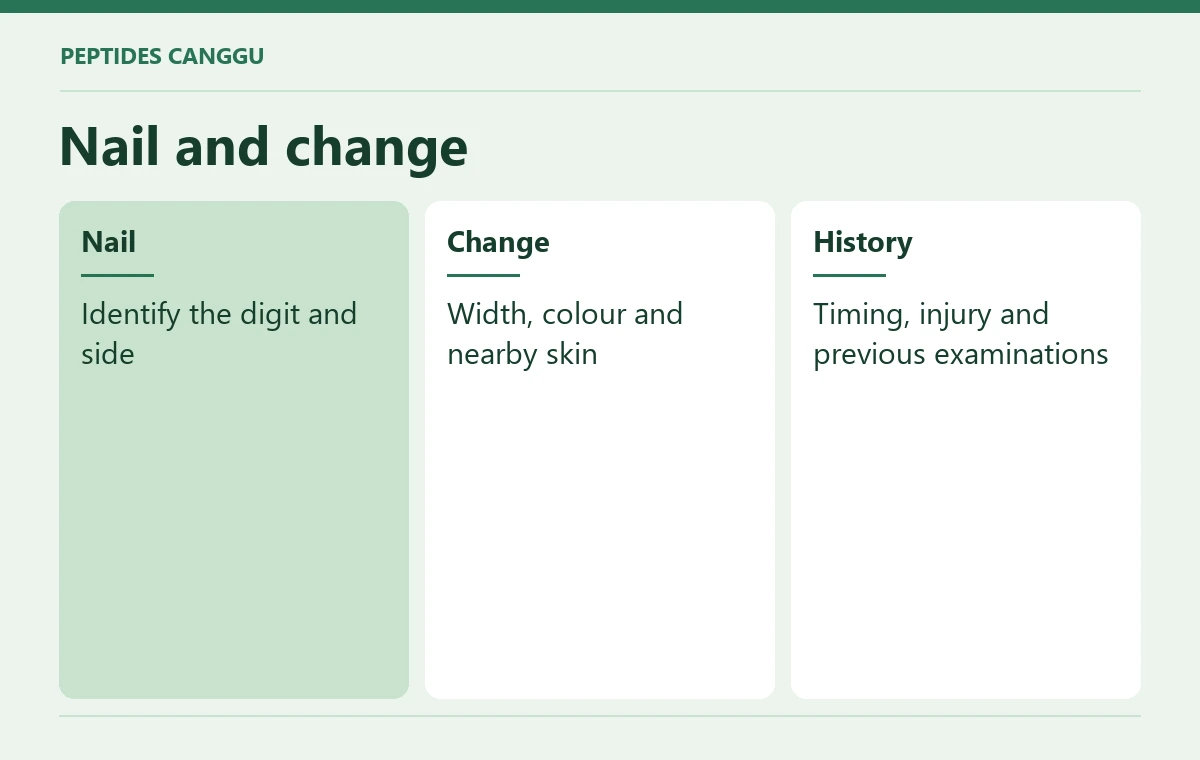
A newly appearing or changing dark band in a nail needs assessment, particularly if only one nail is involved or surrounding skin also changes. Trauma and other conditions are possible; colour alone cannot determine the cause.
What belongs in the photograph?
The American Academy of Dermatology describes nail changes that can be signs of melanoma, including a dark streak and pigment extending onto nearby skin. Not every streak is malignant. Waiting for it to grow out is not a substitute for evaluation of a concerning change. American Academy of Dermatology on signs in and around nails
Unlike a flat spot on the forearm, a nail change has several relevant landmarks. The direction the band runs, its relation to the base of the nail and the appearance of nearby skin can matter when a clinician decides how to examine it. A close-up that excludes the edges may conceal the very feature the person noticed. Take an overview of the digit and an image close enough to show the band, without filters that alter colour. If an earlier picture exists, identify which date and nail it shows.
A plausible injury is still a history, not a diagnosis
If you notice the mark after a surf trip to Canggu, note which nail, when it appeared and whether there was an injury. A clear photograph showing the whole nail and nearby skin may help a clinician track the site. A close cropped picture removes important landmarks.
A toe can be knocked during sport or inside tight footwear. That history can be useful to a dermatologist, but it cannot by itself establish what a persistent or changing band represents. Similarly, the use of a tanning product does not establish the cause of a new nail finding. A clinician can determine whether the location and pattern warrant dermoscopic examination or another assessment. Mention any bleeding, nail lifting or extension of pigment that you noticed. If the timing is uncertain, an approximate date is more honest and useful than an invented precise onset.
Read the result in its original setting
A band visible only under polish or artificial nail coverage may be difficult to document. Tell the clinic about the covering and any recent nail treatment, and follow its guidance about preparation for an examination.
If a previous clinician examined the same nail, note their findings and the date. A note about a pigmented spot elsewhere on the body does not establish what happened at this site.
Arrange a dermatology assessment for a new or changing band. Mention medicines, tanning products and prior injury without assuming any one caused it. An examination is needed to decide whether testing is appropriate.