A growth hormone stimulation test or a suppression test?
A stimulation test asks whether growth hormone can rise in response to a defined challenge.
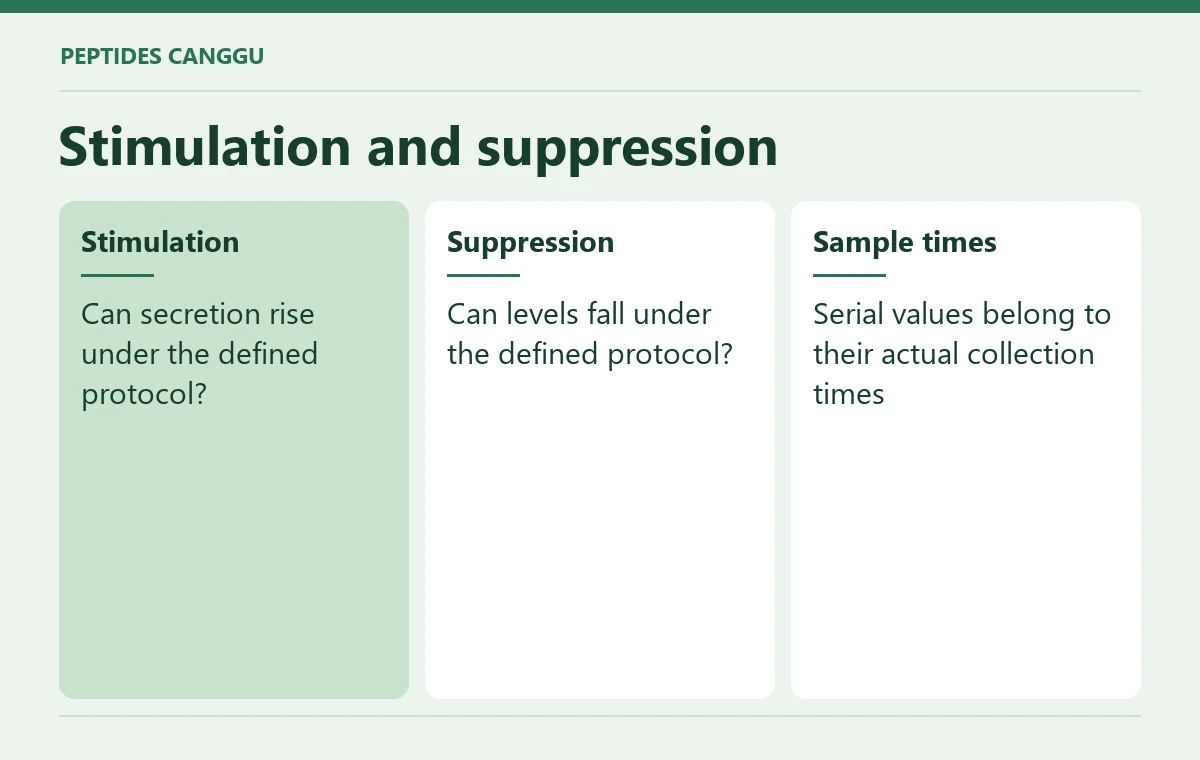
A stimulation test asks whether growth hormone can rise in response to a defined challenge. A suppression test asks whether it falls appropriately under the testing conditions. The two procedures investigate different clinical questions.
Which response was being investigated?
MedlinePlus describes both supervised approaches. Growth hormone is released in pulses, so an isolated result may not represent secretion over time. Serial blood draws and the type of challenge are part of the test itself. MedlinePlus on growth hormone tests MedlinePlus on IGF-1 testing
A stimulation test investigates the ability of the growth hormone system to respond under controlled conditions. A suppression test investigates whether secretion decreases as expected under a different controlled challenge. These tests cannot be compared simply by placing their final GH concentrations side by side. The direction of the expected response, the reason for referral and the preparation are all different. A patient who recalls having had a sugar drink or repeated samples in the past may still need the earlier protocol to identify the test accurately.
The label GH does not identify every measurement
A patient in Canggu arrives with a form simply marked GH. Clarify whether it requests a single measurement, a dynamic test or an IGF-1 measurement before comparing previous values. The words growth hormone on a supplement page cannot identify the ordered protocol.
An IGF-1 report concerns a related hormone and can be informative in growth hormone assessment, but an IGF-1 value is not a substitute for the response curve from a dynamic GH test. Similarly, a baseline GH measurement is one observation taken before the challenge. It does not show what the subsequent series would have looked like. If the previous clinician documented an interpretation, retain the letter with the numerical results. Interpreting hormone tests requires the appropriate protocol, assay and clinical circumstances, particularly when results from different laboratories or different countries are being brought together.
When sharing the finding
Check what the clock starts from on a dynamic test form. A time point written after a stated challenge is not necessarily an ordinary time of day or the time since breakfast. If the information is missing, let the testing service identify the protocol.
The endocrinology team may also need historical findings from before the dynamic test was ordered. Those findings provide clinical context but should remain distinct from measurements collected under the supervised challenge.
Ask the endocrinology service for preparation instructions and the timetable for supervised samples. Trying to reproduce a stimulation or suppression protocol independently cannot generate a comparable clinical result.