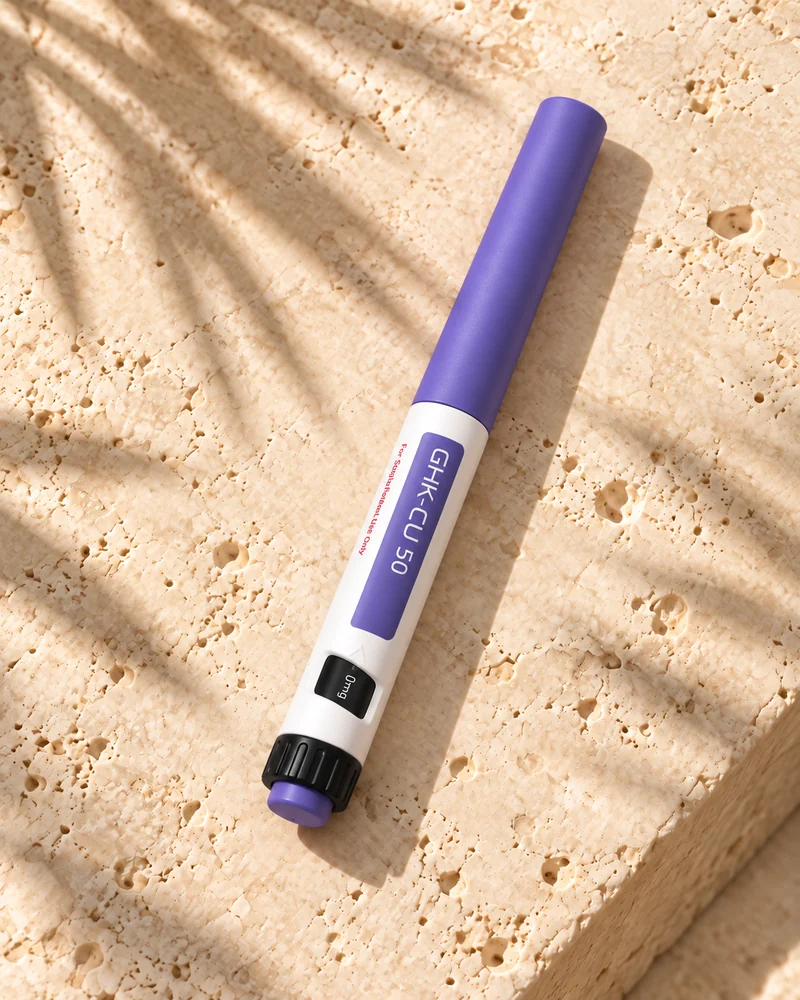

Repair & Glow is a two-pen set: one BPC-157/TB-500 blend and one separate GHK-Cu pen. For a Canggu buyer, the useful question is whether there are two distinct product questions to explore, rather than assuming that a bundle is automatically better for one broad goal. Its name describes a catalogue pairing, not a clinical result.
The exact Repair & Glow contents
| Pen | Declared contents | How to read the total |
|---|---|---|
| BPC-157/TB-500 | 16 mg BPC-157 plus 16 mg TB-500 | 32 mg combined content in that pen |
| GHK-Cu | 50 mg GHK-Cu | Content of the separate copper-peptide pen |
The Repair & Glow listing is the reference for the actual set. The three ingredient names do not mean three separate pens, and they do not mean that all three ingredients share one container. Count the items and read each item's composition separately.
Why tissue research and skin research appear together
The BPC/TB item is associated with tissue and recovery research; GHK-Cu is associated with copper-peptide and skin-matrix research. These interests can be related without being identical. Someone may have a specific skin question, another a diagnosed injury question, and a third simply want to understand a claim about collagen.
A BPC-157 tendon-fibroblast study and a GHK-Cu fibroblast-collagen study illustrate different experimental questions. They do not test this exact bundle in people. The shared tissue vocabulary is not a substitute for evidence that the products work better together.
The practical value of explaining the pairing is clarity: which ingredient is being discussed, what kind of evidence is cited and what outcome remains unestablished. It should not turn separate research topics into a promise of a combined effect.
Compare three options without assuming a winner
| Catalogue option | A useful reason to inspect it | What the option does not prove |
|---|---|---|
| GHK-Cu on its own | You want to examine the copper-peptide product and its documents | That it answers every recovery question |
| BPC/TB on its own | You want the declared two-ingredient blend | That adding a second ingredient guarantees superiority |
| Repair & Glow | You want to compare both listed products together | That combining them is clinically necessary or established |
The GHK-Cu page and BPC/TB page let you examine the items individually. A focused enquiry can begin with one. There is no evidence-based obligation to turn every question into a bundle.
“GLOW” is not a complete specification
Another seller may use GLOW for a premixed product containing similarly named ingredients. That name alone does not establish the same composition, proportions, number of containers or formulation as Repair & Glow. Compare actual labels rather than assuming matching words mean identical products.
This article is not an instruction to mix, transfer or combine solutions. The fact that the set has separate pens is a product detail, not a laboratory method or a clinical combination schedule.
Make a useful enquiry from Canggu
State which item you want explained and the specific question: a research endpoint, the blend composition or the distinction from a cosmetic product. Ask for the matching documents. If the concern is a diagnosed injury or a skin problem requiring treatment, keep that clinical decision with the relevant professional.
Our GHK-Cu buying guide covers the single-product question in more detail. FDA's substance information identifies important uncertainties for BPC-157 and injectable GHK-Cu. Neither a set name nor separate packaging resolves those evidence gaps.
For a visitor in Bali, organize the enquiry around the exact item and actual follow-up needs. For a resident, do the same without letting a broad wellness label replace the outcome you want to understand. The bundle should make the catalogue clearer, not decide the medical question.
Questions readers ask
Is Repair & Glow a single GLOW formula?
No. The listing contains two pens with the composition above. Another product called GLOW may use a different presentation.
Does the set establish synergy?
No. A logical research pairing is not a clinical demonstration of a better combined outcome.
Can I start by comparing only the GHK-Cu item?
Yes. The individual page is a useful starting point for a copper-peptide question. The existence of a bundle does not create a need for its other components.
Sources and further reading
- Pentadecapeptide BPC 157 enhances the growth hormone receptor expression in tendon fibroblasts
- Stimulation of collagen synthesis in fibroblast cultures by the tripeptide-copper complex glycyl-L-histidyl-L-lysine-Cu2+
- Certain Bulk Drug Substances for Use in Compounding that May Present Significant Safety Risks
Prepared with AI assistance and checked against the linked sources. No licensed medical review is claimed.