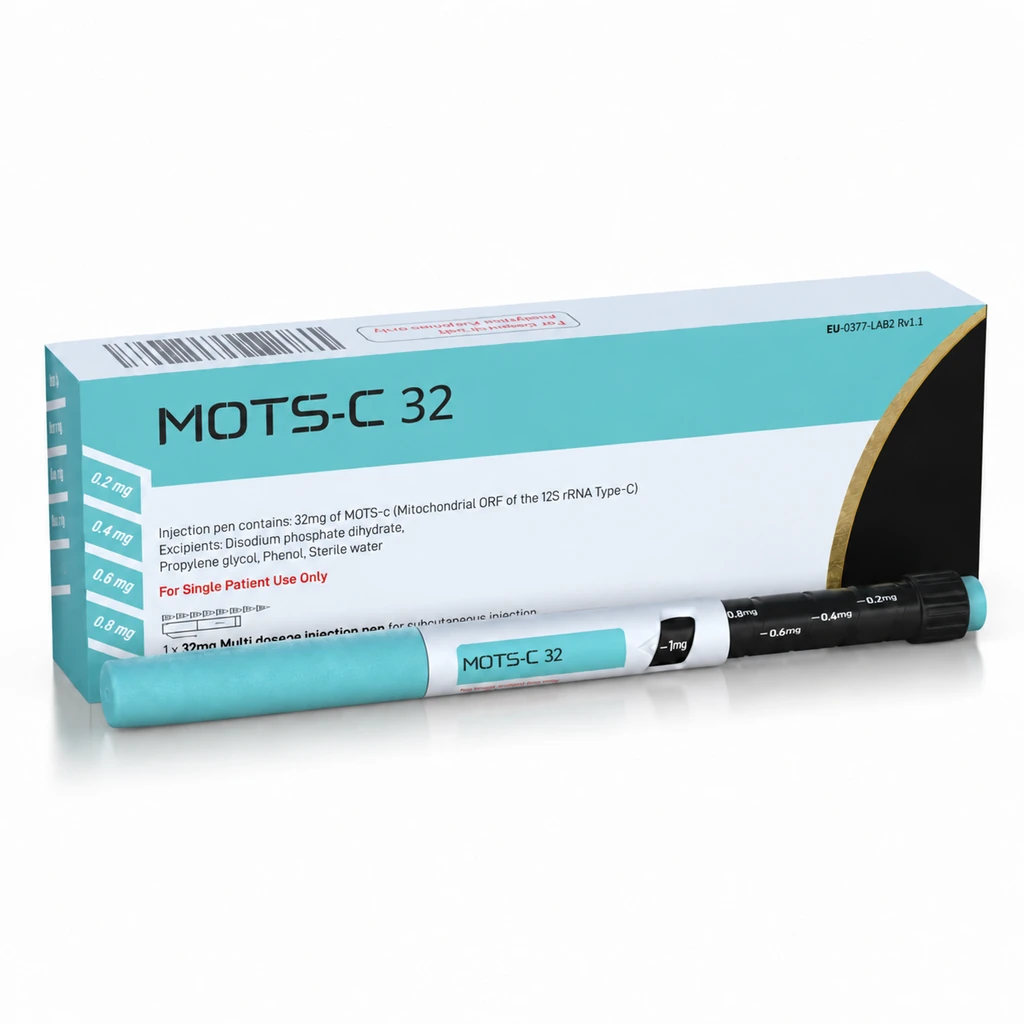
MOTS-C is not another name for Retatrutide or a substitute version of a GLP-1 medicine. The two appear in metabolic discussions for different reasons. When comparing them in Bali, separate mitochondrial-peptide research from receptor-agonist obesity trials, then check what the exact pen label describes. Equal 32 mg totals do not make the products equivalent.
Two different starting points
Retatrutide is a single molecule targeting GIP, GLP-1 and glucagon receptors. MOTS-C is a mitochondrial-derived peptide studied in metabolic and exercise-related contexts. A shared interest in metabolism does not establish the same mechanism, clinical purpose or outcome.
| Question | MOTS-C | Retatrutide |
|---|---|---|
| Research identity | Mitochondrial-derived peptide | Triple-receptor agonist |
| Example evidence | Endogenous exercise observations and experimental work | Randomized obesity trial |
| Key interpretation check | Was administered MOTS-C tested for this clinical outcome? | Does the trial product and population match the claim? |
| Listed pen total | 32 mg | 32 mg |
| Meaning of equal totals | Same mass unit, different molecule | No dosing or efficacy equivalence |
See the catalogue entries for MOTS-C and Retatrutide. The equal number is a labelling coincidence, not a conversion rule.
What MOTS-C observations establish
The Nature Communications research investigated naturally occurring MOTS-C around exercise and included experimental administration work. Observing a physiological signal and proving a benefit from a particular retail preparation are different steps.
This matters when a product description moves from “involved in metabolism” to a promise of weight loss or improved performance. The broad biological connection does not establish the precise customer outcome. Ask what was actually administered, to whom and what was measured.
Our MOTS-C insulin-sensitivity article explores an adjacent measurement question. Insulin sensitivity, body weight and perceived energy should not be treated as interchangeable endpoints.
What the Retatrutide trial establishes
The published phase 2 obesity trial tested an investigational retatrutide preparation in a defined adult population. That is a different evidence design from an endogenous exercise observation.
It provides information about its own intervention and outcomes, not proof for every retail pen carrying the molecule's name. Lilly's current overview continues to describe retatrutide as investigational. Later-stage development news does not remove the need to identify the offered product and its actual status.
Nor does the trial provide a head-to-head answer against MOTS-C. It is reasonable to describe the difference in available evidence without pretending that the two pens were directly compared in the same study.
Define the outcome before choosing a category
Someone asking about metabolism may mean appetite, a laboratory finding, endurance or body composition. Begin with the actual problem. A useful clinical discussion names the endpoint and determines whether it needs a diagnosis, monitoring or a different kind of assessment.
Do not infer that a product in an “energy” category corrects fatigue, or that a product in a weight category is suitable for every person seeking a smaller waist. Category labels help navigation; they do not replace the connection between evidence and an individual's situation.
Why a combination is a separate question
Seeing both names together in a bundle can make the pairing appear established. But a combined offer is not the same as a clinical study of combined use. The cited publications do not demonstrate that MOTS-C adds a particular benefit to Retatrutide.
Different mechanisms alone do not prove synergy or compatibility. If an existing treatment is involved, discuss the exact products with the clinician responsible for it rather than treating the bundle as an automatic next step.
A practical Bali comparison
Keep a short record of the intended outcome, previous treatment, current medicines and available follow-up. Visitors should include travel dates; residents should ask how progress will be measured. Then compare the actual product documents, not just the mass printed on the front.
A useful answer may be that the compounds address different research questions, rather than that one is universally better. That distinction makes the next clinical or product-identification conversation more precise.
FAQ
Is MOTS-C a GLP-1 agonist?
It is a mitochondrial-derived peptide, not the same receptor-agonist design as Retatrutide.
Do two 32 mg labels imply equal strength?
No. Different molecules cannot be ranked using total mass alone.
Is there a direct comparison in the sources cited here?
No. These sources use different study designs and do not compare the two retail pens.
Does combining them guarantee a better result?
No. The cited research does not establish that combination benefit.
Sources and further reading
Prepared with AI assistance and checked against the linked sources. No licensed medical review is claimed.