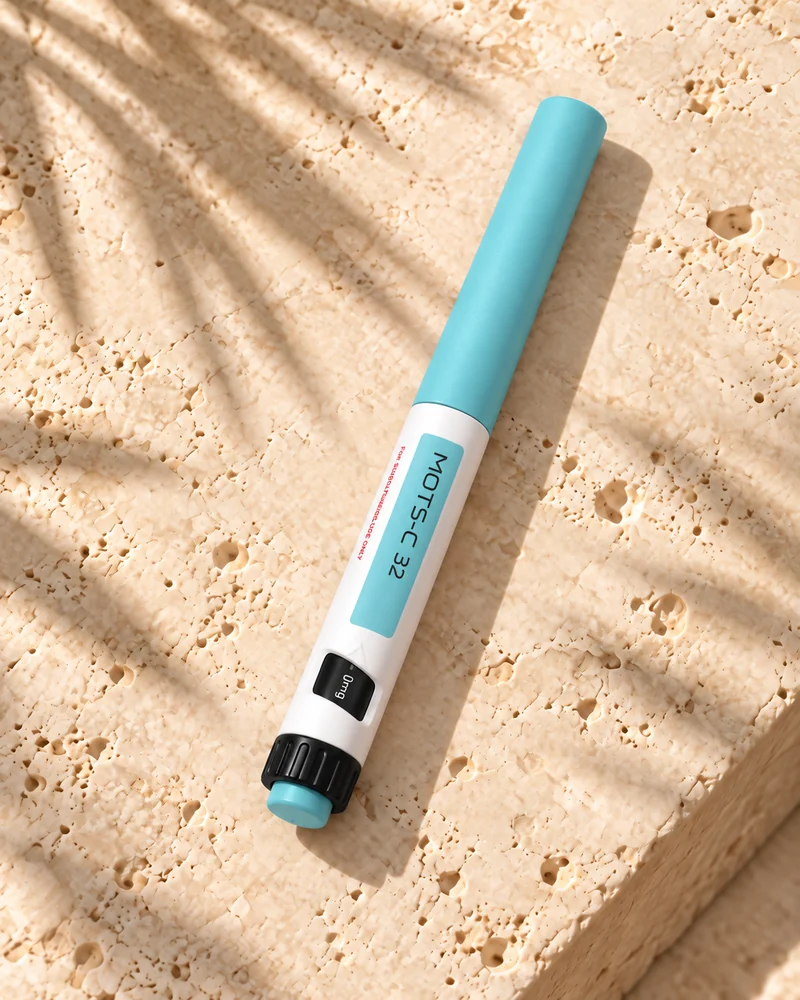

MOTS-C and NAD+ often appear together in Canggu wellness searches, but they answer different molecular questions. MOTS-C is a signalling peptide; NAD+ is a coenzyme. Before choosing between the individual pens or the Feel Good Mode set, separate the goal you mean by “energy” from the biological mechanism and the evidence for the actual product.
MOTS-C vs NAD+: what are you comparing?
| Feature | MOTS-C | NAD+ |
|---|---|---|
| Molecular category | Peptide | Coenzyme |
| Research focus | Mitochondrial signalling and responses to metabolic stress | NAD metabolism and associated biochemical processes |
| A relevant evidence distinction | Natural changes after exercise versus administered product | Metabolite changes versus a meaningful health outcome |
| Listed pen | 32 mg | 1000 mg |
The format numbers describe total labelled contents. They do not mean NAD+ is many times more effective, or that a smaller mass of MOTS-C supplies the same effect. The molecules are not units on one potency scale.
What the MOTS-C research can tell you
The Nature Communications study includes observations of naturally occurring MOTS-C around exercise in humans, alongside experimental work. Observing a change after exercise is not the same experiment as administering a retail pen and showing that it reproduces training benefits.
That is the key distinction behind “exercise mimetic” language. A research description of signalling does not establish that a pen replaces activity, improves a particular workout or treats unexplained tiredness. Our MOTS-C cellular-energy guide examines the outcome question in more detail.
What the NAD+ research can tell you
A small intravenous NAD+ pilot study measured plasma and urine metabolites during an infusion. That is useful pharmacological context, but it is not a clinical trial showing that a subcutaneous NAD+ pen improves energy, reverses aging or produces the same exposure as an infusion.
Three questions must stay separate: whether the molecule is involved in a biological process, whether administration changes a measured marker and whether people experience a useful clinical benefit. A positive answer to the first does not automatically answer the other two.
Turn an “energy” claim into a question you can evaluate
Use three columns when reading a product description: the promised outcome, what the cited paper measured, and whether it used the offered formulation. A claim about daytime tiredness is not answered by a molecule's role in cellular metabolism alone. A gym-performance claim needs an actual performance outcome, not simply a different blood marker.
This is useful for both a Canggu resident and someone who has just arrived in Bali. State whether the concern is new, persistent or tied to a particular situation. The purpose is to make the discussion concrete, not to diagnose the reason from a catalogue category.
Persistent fatigue or a meaningful change in function belongs in a clinical assessment. A shopping comparison cannot establish its cause. The FDA's MOTS-C information also identifies important human-safety information gaps; the word “mitochondrial” does not resolve them.
Single product or Feel Good Mode?
The MOTS-C listing states a 32 mg pen. NAD+ is a separate 1000 mg pen. Feel Good Mode pairs those two products; it does not create one mixed solution or demonstrate a clinical interaction between them.
The connection is the broad metabolic research area through different molecular roles. That makes a comparison understandable, but it is not evidence that everyone with one goal needs both products. If you cannot identify a separate question for the second ingredient, a bundle name should not create one for you.
Send the exact product page when asking the team about formats and documentation. Ask for evidence relevant to the actual outcome rather than accepting a study of another route or substance. The product details and clinical question should remain distinguishable in the answer.
Questions readers ask
Does an energy-related category mean the two pens are substitutes?
No. A common category groups different research interests. It does not establish the same mechanism or interchangeable clinical effects.
Can a study of naturally occurring MOTS-C validate an injected pen?
Not by itself. Observing an endogenous signal and administering a product are different interventions, with different questions to answer.
What if I only want information about NAD+?
Start with that molecule and the exact format. There is no need to assume that the bundle's second ingredient belongs in the question.
Sources and further reading
- MOTS-c is an exercise-induced mitochondrial-encoded regulator of age-dependent physical decline and muscle homeostasis
- A Pilot Study Investigating Changes in the Human Plasma and Urine NAD+ Metabolome During a 6 Hour Intravenous Infusion of NAD+
- Certain Bulk Drug Substances for Use in Compounding that May Present Significant Safety Risks
Prepared with AI assistance and checked against the linked sources. No licensed medical review is claimed.