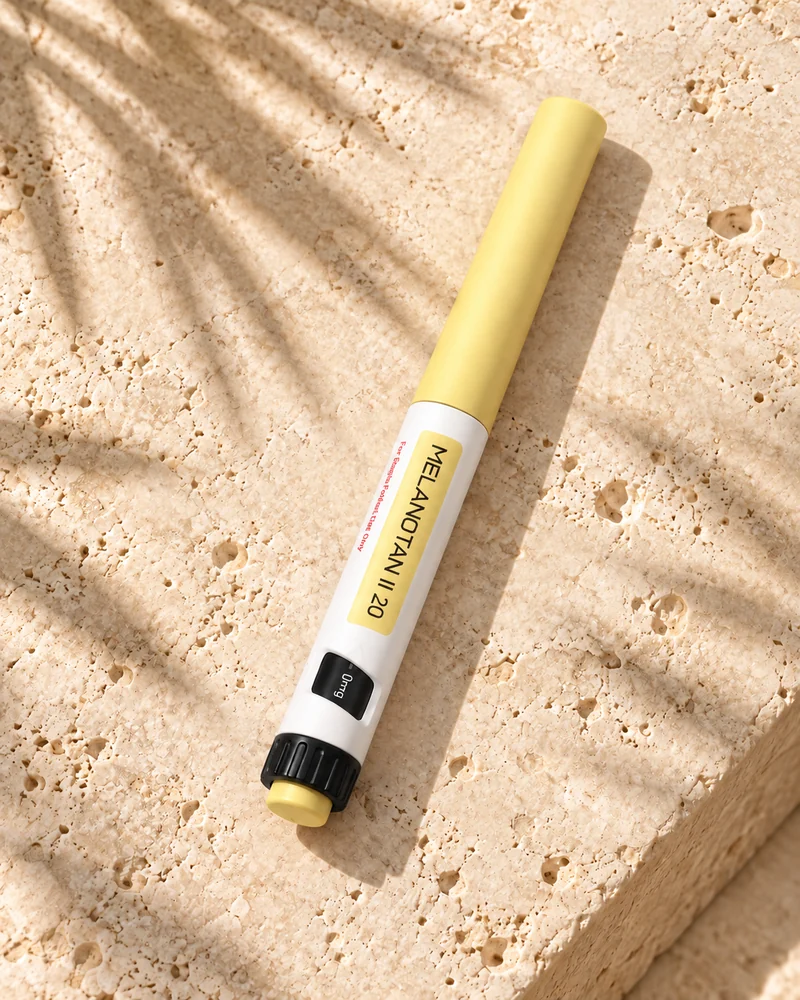

Afamelanotide in Scenesse and Melanotan II are different products with different identities. For someone searching from Canggu, the most useful question is not whether both names are associated with pigmentation, but which substance, formulation and medical indication a claim actually concerns. An authorization for a named implant does not validate an unrelated tanning pen.
Melanotan II vs afamelanotide: the useful comparison
| Question | Melanotan II | Afamelanotide in Scenesse |
|---|---|---|
| Name to identify | Melanotan II, also written Melanotan 2 | Afamelanotide, the active substance in Scenesse |
| Product discussed here | A labelled 20 mg pen | A specific medicinal implant |
| Why it appears in searches | Pigmentation and tanning discussions | Treatment of a defined photosensitivity disorder |
| Can the other product's approval be borrowed? | No | Approval concerns the actual medicine and indication |
The European Medicines Agency's Scenesse assessment describes afamelanotide for prevention of phototoxicity in adults with erythropoietic protoporphyria, or EPP. That is a particular medical condition and a particular product, not a general endorsement of products sold for tanning.
Why the medical indication changes the question
EPP is the context of the authorization discussed by EMA. Replacing that context with “getting a tan before a Bali holiday” changes the clinical question. The original medicine's evidence cannot simply be reworded as proof of a different cosmetic goal.
This is an example of an approval-transfer mistake: a reader recognizes a related name, sees that a medicine exists and assumes the offered product inherits its evidence. The correct comparison keeps the active substance, presentation, manufacturer documentation and intended indication together.
The same care applies to the word “implant”. It describes a specific presentation in the Scenesse information. It does not make a separately offered pen an equivalent delivery system, and the quantity on either label is not an equivalence factor.
Three details a short product name can hide
First, read the full active-substance name. “Melanotan” alone is not a precise specification. A webpage may discuss one molecule in its scientific background while offering a different one. The name in the actual listing is the one that needs matching documentation.
Second, identify the presentation. An implant, a nasal product and a pen are different formats. A result from one format cannot simply be transferred to another because both are associated with skin colour. Our nasal-versus-injectable comparison examines that separate route question.
Third, identify the endpoint. Preventing phototoxicity in a diagnosed condition is not the same as changing a holiday photograph. The patient population and measured result are part of a study, not optional details that disappear when a product is advertised.
How to read the Canggu catalogue entry
Our Melanotan II page describes a 20 mg pen. It does not list afamelanotide or the Scenesse implant. The total content is an identification detail, not a treatment instruction or proof that the product has another medicine's status.
The comparison is useful precisely because it prevents those names from blending together. If you ask the team about this item, use the exact link and request information for that product. If the reason for your question is a diagnosed skin condition, take the clinical question to the professional managing it.
The Therapeutic Goods Administration's melanotan warning identifies health risks from tanning products and explains the Australian context. It supports a material safety distinction; it does not determine the registration status of a specific product in Indonesia.
Avoid turning pigmentation into a sun-exposure target
A darker appearance does not answer whether a product is appropriate, whether a skin change needs review or how much sun exposure is safe. An article about the medical implant should not be used as a reason to extend time in the sun while visiting Bali.
For a related question about starting skin colour, our Melanotan II and phototype guide explains why the starting point matters. Neither that guide nor a product comparison replaces assessment of a changing skin lesion or another clinical concern.
This is a more useful distinction than a broad “approved peptide” label. The exact medicine, indication and presentation stay together, while the catalogue listing is identified on its own terms.
Questions readers ask
Can a Scenesse study be cited as proof for a Melanotan II pen?
It can explain the related medical field, but it does not establish the effect of a different substance and formulation. The product and research must match the claim.
Does an implant amount tell me an equivalent pen amount?
No. A quantity is not a conversion across different substances and delivery systems. This comparison provides no administration schedule.
What should I clarify if a description says “approved”?
Ask which exact product, regulator and indication it means, and whether the offered item is that product. The molecule name alone is insufficient.
Sources and further reading
Prepared with AI assistance and checked against the linked sources. No licensed medical review is claimed.