Research has examined whether microneedles can increase GHK-Cu penetration through skin. That is not the same as proving that any GHK-Cu product can be safely added to a cosmetic microneedling session. If you are considering a procedure in Canggu, ask about the exact device, formulation and clinical evidence for the combination being offered.
Penetration and visible results are different endpoints
The study Microneedle-Mediated Delivery of Copper Peptide Through Skin used experimental skin models to measure delivery through treated skin. Its findings address penetration under the study's conditions. They do not establish a facial rejuvenation result in a living clinical population using a retail pen.
That distinction is easy to lose when a treatment page describes enhanced absorption as enhanced results. More of an ingredient crossing a barrier is a delivery finding. A cosmetic or medical outcome still needs appropriate clinical assessment.
| Claim | Evidence needed |
|---|---|
| An ingredient crosses the skin more readily | Relevant delivery or penetration measurements |
| A finished combination improves a skin concern | Clinical outcomes for the specified product and procedure |
| A particular combination is suitable | Device, formulation and patient-specific assessment |
| A pen can substitute for a procedure serum | Product information supporting that route and use |
The device and the applied product must both be identified
A device may have information supporting particular uses, but that does not establish every additional product someone puts on the skin. The FDA's microneedling information explicitly distinguishes device clearance from unverified combinations with other products.
This is a useful evidence distinction, not a statement that a specific Canggu clinic does or does not hold a local authorization. Ask the practitioner to identify the actual device, intended procedure and formulation used. “Copper peptides” alone is not enough detail.
Why a catalogue pen is not a ready-made cosmetic ingredient
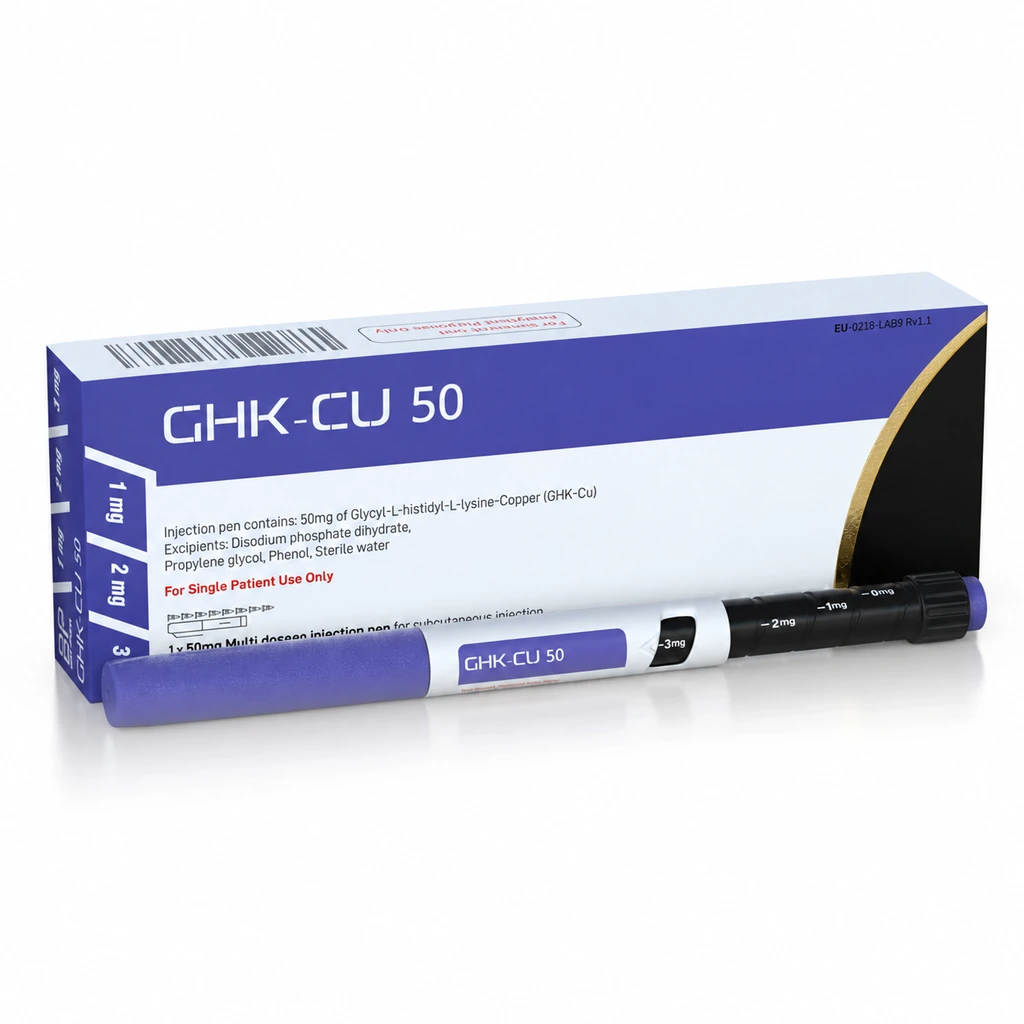
The GHK-Cu catalogue entry lists a 50 mg pen. It does not identify that pen as a topical microneedling serum. A label amount cannot establish compatibility with a device, an opened-skin procedure or a different application route.
Do not infer a new use from the fact that the same molecule appears in a paper. The study formulation, the pen and a finished cosmetic product may differ in concentration, other ingredients and intended route. Those details can matter even when the headline ingredient name is identical.
The earlier GHK-Cu fibroblast work offers biological context, but it also does not authenticate a particular microneedling protocol. Combining a cell experiment with a penetration experiment does not automatically produce a clinical trial of the offered procedure.
Questions for a Canggu skin consultation
Explain the specific concern you want assessed, such as a scar or a change in texture, rather than asking for a generic “collagen boost.” Ask what endpoint supports the recommendation and whether the evidence concerns the complete procedure.
Request the product's exact name, its intended use and the reason it is being paired with the device. Clarify aftercare, how questions or reactions will be handled and who will review the result. For a visitor, provide your departure date so the plan does not assume you remain nearby.
Our GHK-Cu skincare checklist helps distinguish ingredient information from finished-product information. The skin-change tracking guide explains why consistent documentation matters when assessing a result.
Keep the comparison interpretable
If several procedures and new products begin together, a later photograph cannot identify which caused a change. Keep a record of the actual products, procedure date and follow-up advice. Share existing skin treatments and relevant history with the practitioner.
An article cannot determine the best procedure for an individual or specify how soon a cosmetic ingredient should be restarted afterwards. Those instructions need to come from the professional responsible for the specific treatment, not from a generic ingredient pairing.
A specific plan should also distinguish the procedure product from the products intended for later home care. Ask for that distinction in writing if several bottles or devices are mentioned. A recommendation to use a cosmetic on intact skin after recovery does not automatically authorize applying it during a procedure that changes the skin barrier.
FAQ
Does better penetration prove better cosmetic results?
No. Delivery is one research endpoint; visible clinical outcomes are another.
Can I use pen contents as a microneedling serum?
The cited evidence does not establish that use. Do not repurpose the catalogue pen based on a shared ingredient name.
Does a device's approval cover every added product?
No. The device and the combination with another formulation require separate attention.
Can a before-and-after photo establish the best pairing?
It may document a change, but cannot by itself isolate the responsible intervention or establish safety and effectiveness for others.
Sources and further reading
Prepared with AI assistance and checked against the linked sources. No licensed medical review is claimed.