BPC-157 and platelet-rich plasma, or PRP, are different things. BPC-157 is a peptide; PRP is a preparation derived from a person's blood. Neither should be chosen for a Bali training injury simply because both are described as “regenerative.” The diagnosis, the preparation and the outcome studied are more useful comparison points.
Start with the actual treatment being compared
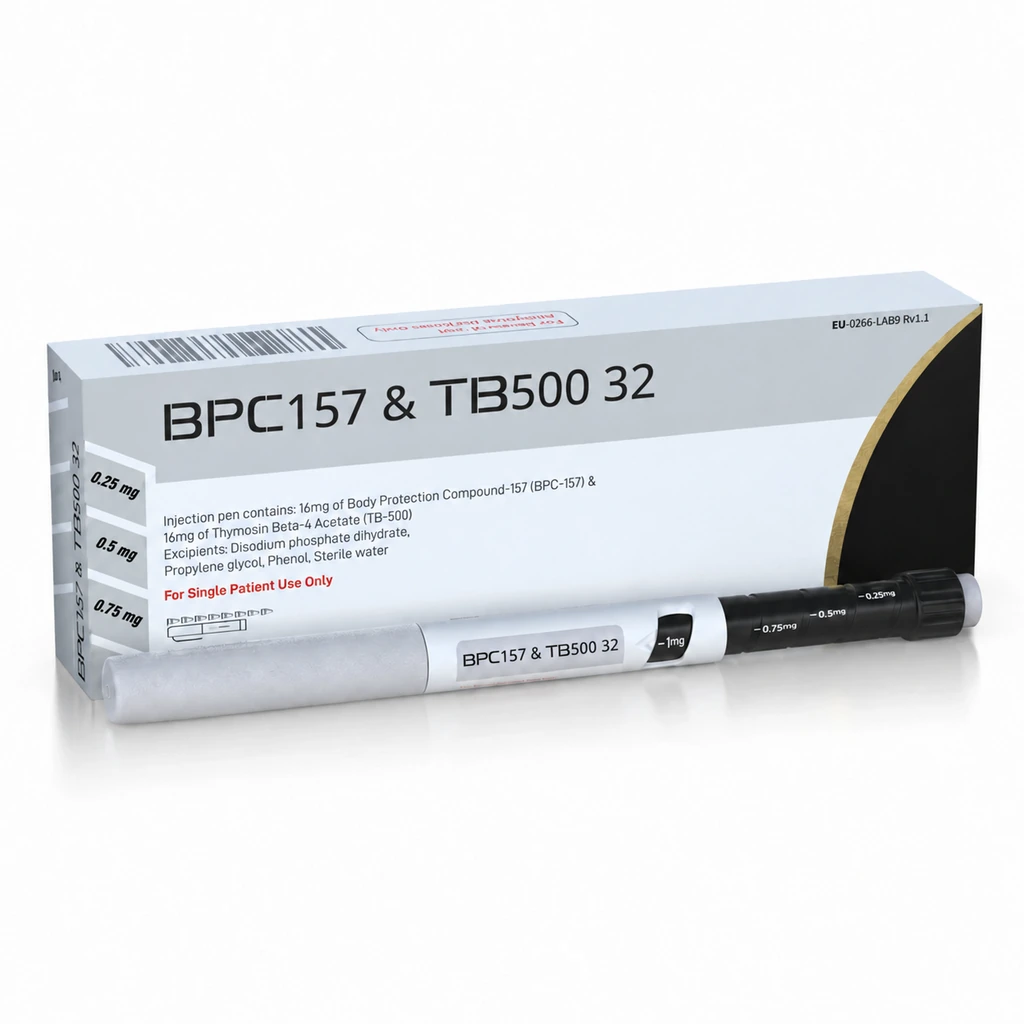
The local catalogue offers a BPC-157/TB-500 pen, not isolated BPC-157 and not a PRP procedure. Its labelled total is 16 mg of each peptide, 32 mg combined. A study of BPC-157 alone does not automatically establish the result of that blend.
PRP is produced from blood and administered in a clinical procedure. Its composition and application can vary. Calling something “PRP” does not guarantee that it matches the preparation used in a particular trial.
| Question | BPC-157/TB-500 pen | PRP procedure |
|---|---|---|
| What is supplied? | A two-peptide product | A blood-derived preparation and procedure |
| Main identity issue | Exact blend and formulation | Preparation method and application |
| Relevant outcome | Evidence for the condition and actual product | Evidence for the condition and procedure |
| What cannot be assumed | Results of single-compound studies transfer to the blend | All PRP methods produce the same result |
What an Achilles trial tells us
A randomized sham-controlled JAMA trial studied PRP for chronic midportion Achilles tendinopathy. It did not find the anticipated improvement in tendon dysfunction versus the sham procedure at the primary follow-up.
That is a meaningful result for the studied condition and method. It does not mean every PRP use in every joint is ineffective. Just as importantly, a disappointing PRP result is not evidence that BPC-157 works better. A direct comparison would require a study actually testing that question.
What BPC-157 laboratory evidence tells us
The BPC-157 tendon-fibroblast paper investigated a biological mechanism in an experimental setting. It helps explain scientific interest in tendon research. It does not establish a return-to-running time, a healed Achilles tendon or a clinical advantage for a retail blend.
The FDA's discussion of certain compounded substances describes important evidence and safety uncertainties for BPC-157. This is not a claim about a particular Indonesian seller's registration; it is a reason not to convert mechanistic research into a confident clinical promise.
Why the diagnosis changes the comparison
“Tendon pain” can describe different locations and situations. Ordinary soreness, a chronic tendon disorder and an acute injury are not interchangeable research populations. A product comparison made before that distinction may answer the wrong question.
Bring the location, onset and functional limitation to an appropriate clinician. Include previous assessments, imaging if already performed, and changes in activity. If you have difficulty with normal movement or a sudden injury, seek assessment rather than using an online comparison to delay it.
Make the desired outcome concrete
Ask whether the proposed approach is supported for pain, function, return to activity or an imaging finding. These endpoints need not move together. A testimonial about feeling better is different from a controlled functional result, and a biological mechanism is different again.
Our article on soreness and BPC-157 helps define one common confusion. The BPC-157/TB-500 product page identifies the catalogue preparation so that a clinical discussion uses the correct name.
Planning care around a Bali stay
Visitors should tell the assessing professional how long they will remain locally and who can follow up after departure. Residents should clarify how progress will be measured rather than judging only by an immediate sensation after a procedure.
Neither a pen purchase nor a procedure name supplies a full injury-management plan. Comparing them responsibly includes the rehabilitation and review context, without assuming that one replaces the other or that combining them produces an extra benefit.
FAQ
Is PRP another peptide injection?
No. It is a blood-derived preparation, not a named peptide molecule.
Does the Achilles PRP trial prove BPC-157 is better?
No. The trial did not compare PRP with BPC-157.
Can a BPC-157 paper be treated as proof for a BPC/TB blend?
Not automatically. The formulation, ingredients, route and studied outcome must match.
Can either option promise a return-to-sport date?
The sources discussed here do not establish a personal recovery deadline. That depends on the actual condition and clinical course.
Sources and further reading
- Effect of Platelet-Rich Plasma Injection vs Sham Injection on Tendon Dysfunction in Patients With Chronic Midportion Achilles Tendinopathy
- Pentadecapeptide BPC 157 enhances the growth hormone receptor expression in tendon fibroblasts
- Certain Bulk Drug Substances for Use in Compounding that May Present Significant Safety Risks
Prepared with AI assistance and checked against the linked sources. No licensed medical review is claimed.